Friday, June 4, 2010

Aliens

I know I've been away for a while, but I'm back now, and hope to get into updating this daily (But, let's be honest...it's not gonna be daily) with stuff I've seen.


Aliens (Cameron, 1986):  The way 2010 cinema has been completely underwhelming is disappointing on one level (Seriously, I think 8 of the 18 local screens are showing either Iron Man 2 (Understandable), Sex and the City 2 (Kind of a travesty, but it's popular, so I get it), or Robin Hood (Completely baffling that it takes up three theaters when it's not even making that much money!), but good on another as rather than wasting my time and money, it gives me a chance to get around to stuff I've been meaning to watch for years, hence, Aliens!  I actually only got around to Alien, itself, last year, and now seemed like a good chance to delve into the sequel.  If you're completely bizarre like myself and somehow never got around to watching this, I'll give you a brief synopsis. Sigourney Weaver reprises her role as Ripley, former space worker turned alien fighter, who is discovered some 50+ years later floating in space.  Of course, the evil corporation blames her and not the bloodthirsty aliens for ruining things and she's given the space worker equivalency of a dishonourable discharge, and finds herself working the space docks, that is, until slimy corporate bigwig Paul Reiser enlists her to travel to a mining colony on the planet where the aliens were discovered that has recently broke off all contact.  She hesitates, at first, but you know she ends up going along with a group of gung-ho space marines who are, of course, completely inept when it comes to dealing with the titular creatures who have ravaged the colony, leaving only one survivor, a little girl called Newt.


As someone who's not really big on scary movies (For the most part, I don't really find them that all scary, save a few (Audition scared the pants off me and my friends; Paranormal Activity was good for a few scares, and I found The Strangers shockingly effective)), I can honestly say that, really, Aliens might be the scariest movie I've ever seen.  You're gonna have to watch it alone, late at night, with the lights off to get the full effect, probably, but I found myself legitimately on the edge of my seat, even though I'd actually already spoiled the ending for myself trying to figure out how long it was.  The scares were genuinely scary and the effects were pretty spectacular for the most part (A couple times the alien kinda minced along which was a tad distracting), and really spectacular when you consider it was 1986 (But, really, would you expect anything less from a James Cameron movie).  The cast, save for Weaver and Lance Henriksen in the role he was born to play (a creepy robot), were pretty non-descript and superfluous to the plot (But, really, would you expect anything less from a James Cameron movie).  I've got to say, Aliens is the rare sequel that outdoes the original (Except for, say, Indiana Jones and the Last Crusade, Spiderman 2, or, especially, Teenage Mutant Ninja Turtles II).


Lesbian Vampire Killers (Claydon, 2009):  This was just bad. It's kinda like if someone was sitting around watching Shaun of the Dead and thought to themselves "Hey, I could do that!  But this time with vampires!  And boobies!"  But, no it turns out, you really can't.  The leads are unlikable, the jokes are mostly unfunny, and, by the time you get to a few that aren't so bad - Chubby McSidekick Who Would Kill To Be Nick Frost getting hit with an axe-handle and sniggering at a phallus-shaped sword, as well as the film's final shot, come to mind - the movie's already badly worn out its goodwill with you that you'll choose not to laugh out of spite.  Anyways, yeah, the effects are bad, the characters annoying, the plot, such as it is, drags, and the movie ends with the hope of turning it into a series.  I'd suggest that hope may be a tad unfounded.


Monday, January 18, 2010

Film Review: Blue Collar


Man, flick my bic!


Blue Collar (Directed by Paul Schrader, 1978) Blue Collar stars Richard Pryor, Harvey Keitel and Yaphet Kotto ("The Oreo Gang" they are dubbed at one point in the film) as three workers at an Auto Plant. Pryor's Zeke is a family man with mounting bills, and a distrust of his own union, when he is paid a visit by an IRS representative who questions why Zeke has six children listed on his tax returns but only medical records for three of them ("Where is Stevie Wonder Brown?" he asks). In a wonderful scene Zeke tries to placate the tax man while his wife sneaks next door to borrow the neighbour's children to pass off as her own. Of course, the IRS rep doesn't buy it, and he's demanding back taxes of over $2000 to be paid immediately. Then, Jerry (Keitel) comes home to find his daughter's gums all cut up after she tried to fashion a homemade set of braces out of wire, because Jerry can't afford them, despite the fact he works at two jobs. Meanwhile, Smokey (Kotto) blows his salary on women, liquor and drugs.


Each of them realizes individually that they need to make a change in their lives, finance-wise, and Smokey and Zeke decide to rob their own union. Eventually, Jerry is won over to the idea, and they manage to steal the safe, one night. The safe contains a mere $600, which they have to split four-ways (Each of them gets some, another share to the man who planned it), and Zeke is put in charge of disposing of the safe and the rest of its contents. This is when Zeke comes across a very interesting by-product of their theft: a ledge detailing a list of the union's massive amounts of illegal loans. They're torn as to how to use it: Smokey wants to blackmail the union into paying them, Jerry wants to just get rid of it, while Zeke has the grandest plans: to use it to bring about changes in the union, get himself some power, create a union that will work the way it's supposed to, for the people, not against them.


Things start to go sour, though, when the union claims that $20,000 has gone missing, and Smokey realizes if they're going to pursue this, that the three can no longer be friends, before someone puts two and two together, and pins the crime on them. That means there's no one there to prevent Smokey having a work-place "accident", without Zeke or Jerry to watch his back. There's also no one to prevent Zeke from having the wool pulled over his eyes by the union's promises of power and change. And, there's no one to watch out for Jerry, the most reluctant of the bunch to participate, who now finds his family and himself in danger of goons hired by the union, brandishing shotguns.


Pryor is a major revelation, here. He was always funny, and always entertaining, but here he takes it to another level, playing Zeke as a simmering cauldron of rage and ambition. The look on his face as he realizes he sold Jerry out, but that he did it to save himself, is wonderful, as is his reaction when Jerry returns the favour. And Yaphet Kotto is awesome playing Smokey as a big, tough bad-ass who is the only one, in the end, who ever knew what was going on and how things would turn out.


Tremendous, tremendous film. If you can find a way to track it down (Its run on DVD was long ago discontinued and seems to be selling for upwards of $45 on Amazon), you should do so (I caught it on Encore Avenue, a Canadian cable channel). Paul Schrader is probably the most important American filmmaker that no one ever seems to talk about.

Thursday, January 7, 2010

I'm like my mother, I stereotype. It's faster.


Up in the Air (Directed by Jason Reitman, 2009): This was a nice film, with mostly nice people, having a nice time. It didn't blow me away, but I had a perfectly nice time watching it.


George Clooney plays Ryan Bingham who is hired out to various corporations who are too cowardly to fire their own employees. He lives in airports, on airplanes, and in hotel rooms. He meets a Alex (Vera Farmiga), and the two have a playful flirtation with credit cards and frequent flyer miles as aphrodisiacs. After a wild night of love-making, they sit down with their laptops and plan out when they can see each other again, then part ways, the perfect arrangement for a man with no fixed address.


Of course, whenever someone has a perfect set-up, like Bingham believes he does, life always has to throw a monkey wrench into the gears of your plans. Bingham's particular monkey-wrench is young corporate recruit Natalie (Anna Kendrick), who has the new breakthrough idea of grounding Bingham and his fellow firers, and have them do their firing via internet, taking an already horribly dehumanizing process, and making it moreso. Bingham objects, not just because it puts his titular lifestyle in jeopardy, but also because he believes that he plays an important role, that he takes people at their absolute lowest, and gives them a shred of dignity, and a tinge of hope. His boss isn't convinced, but plays along, and sends Ryan and Natalie out on the road together with Ryan showing Natalie the ropes, and Natalie convinced she already knows them.


I really expected there to be an awkward forced romance between Kendrick and Clooney, who is 24 years her senior, but, refreshingly, the film sidesteps any hint of romantic tension by having Bingham listen in on Natalie's phonecall with her fiancee where he overhears her describe him as 'old'.


Naturally, commitments finally come calling for Bingham, and he finds himself forced to help out with his sister's marriage, even having to try and convince her reluctant husband-to-be (Danny McBride, who is always a treat to have turn up in a film) that the lifestyle he's choosing is a good one, even as Bingham eschews the life, himself. Gradually, more and more, he starts to believe it, and the idea of giving it all up finally has to cross his mind.


Clooney has maybe never been better (It's this or Michael Clayton, as far as I'm convinced), and Farmiga and Kendrick are both wonderful, as well. There's lots of shots from planes, on planes, and of aerial photography above some cities, all of which I'm a sucker for. The characters are believable, as is the dialogue, and everything is competently directed. It's just that I kept waiting for that revelatory moment where you go "Oh, wow!" or "I know exactly what he means!" but it never quite gets there. It's like listening to an old friend tell a funny story you've heard before. It's nice, it won't change your life, but there are worse things to do, so you just sit back and enjoy it.

*** (But, I might bump it up a whole 1/2 star, as I stew on it in the coming weeks)


Be Italian!


Nine (Directed by Rob Marshall, 2009): I'm not really a big fan of musicals, nor was I really that taken with 8 1/2 (Which is what the Broadway play that this is based on was based on), but I figured with Daniel Day-Lewis, I could no wrong. And Lewis is excellent, hitting his Italian accent perfectly (More on that later...) and actually delivering a surprisingly solid singing voice. Penelope Cruz is a lot of fun, radiating raw sexuality from every pore, as his saucy mistress, and Marion Cotillard's song is really good and sad. But, that's about as far as my goodwill extends with this one.


Lewis plays Guido Contini, visionary Italian director, who is struggling with writer's block on his latest film, and spends most of his time moping and sulking, and remembering all the women in his life. There's Luisa (Cotillard) his patient wife, who he makes a point of leaving behind when he retreats from Rome to get away from the press. There's his ongoing mistress (Cruz), who is getting tired of being kept in the dark, even as she worries about upsetting her husband. There's his mother (Sophia Loren), his costumer (Judi Dench), his star (Nicole Kidman), his childhood obsession (Fergie Ferg), and a smitten American journalist (Kate Hudson, who delivers a particularly awful rendition of a particularly awful song). We don't really learn anymore about them than that. He loves his wife, but enjoys cheating on her. He loves his mother (presumably) and lets his costumer boss him around, while she basically helps run his life for him. He also seems to love his star, but never acted on it. He even goes up to the journalist's room, but runs out before doing anything.


That's pretty much it really. The songs aren't that memorable. The performances aren't that great. And you never really learn anything about anyone or anything. And -blasphemy of blasphemies!-, there's no closing number! It just sort of ends. I'd call it a disappointment, but, then again, I didn't really expect anything out of it.

**

Wednesday, January 6, 2010

Film Review: The Bad Lieutenant: Port of Call, New Orleans

I'll kill all of you. To the break of dawn. To the break of dawn, baby.

Bad Lieutenant: Port of Call, New Orleans (Directed by Werner Herzog, 2009): On paper, this looked like a surefire cinematic abortion. A remake of/sequel to a film that was overrated in the first place. Nicholas Cage in the lead of a Werner Herzog film, after a largely forgettable decade by the former. A character played by rapper Xzibit of 'Pimp My Ride' fame.


And it all works! And works like gangbusters!


Cage plays the titular cop, Lt. Terence McDonagh, seen first in the closing days of the Hurrican Katrina disaster, mocking a prisoner trapped in a rapidly flooding prison. After hemming and hawing about ruining his fifty dollar underwear, McDonagh finally dives in and saves the prisoner. He earns a commendation and promotion from the police force, but also winds up with a lifetime of back pain and a prescription for pain pills. The pills are a slippery slope for McDonagh, and, before we know it, we're watching him snort cocaine off the back of his hand, stealing drugs from club-hopping teenagers, and borrowing from a prostitute (Eva Mendes).


A crime occurs that seems to focus McDonagh's maniacal rage like a lazer. A family is killed, execution-style, by a notorious gangster Big Fate (Xzibit) and his cronies. McDonagh sniffs out a lead and finds a scared fifteen-year-old who finally agrees to testity. The boy is left in McDonagh's care, and the scene of Terence going out to dinner at a casino with the boy, his own father's dog (who he agrees to babysit while his father enters A.A.), and his prostitute girlfriend is hilarious.


The boy flees, McDonagh is left without a witness and Big Fate goes free. Left to grasp at straws for the case, McDonagh has the added pressure of a mounting gambling debt, a pay-off for a local gangster after he roughed up a client of his girlfriend's, and pressure from Internal Affairs after his has-to-be-seen-to-be-believed treatment of a woman and her nurse in an assisted care facility. When all this pressure becomes too much, McDonagh has to turn to Big Fate to help him out.


It's a terrific film, instead of relying on the heavy guilt and pathos of the first film, Herzog instead chooses to make Bad Lieutenant: Port of Call, New Orleans about, as he puts it in interviews, the "bliss of evil", and has the film straddle the line between gritty cop drama and black comedy, sometimes throwing in sequences, seemingly at random. There's a scene from the point-of-view of an alligator, McDonagh's increasingly erratic behaviour, hallucinations, and a break-dancing soul.


As for Cage, he hasn't been this riveting, this convincing, since Adaptation. He has the look of a man who has seen the inner contents of his own soul, and is terrified by what he sees, while simultaneously laughing at the weirdness of life. And the supporting cast is terrific: Jennifer Coolidge as his father's girlfriend who doesn't understand why the alcoholic can't just "stick to beer" like she does, Brad Dourif as his put-upon bookie, Michael Shannon as the man in charge of the evidence room growing weary of helping McDonagh score, Fairuza Balk, Shea Whigham, Irma P. Hall, and Val Kilmer, the only cop who might be too bad for McDonagh.


An alternately startling and hilarious film. It will leave you laughing just as many times as it has you cringing, and just as often as it will have you completely dumbfounded. Thus far, it's the best film from 2009 that I've seen.

****


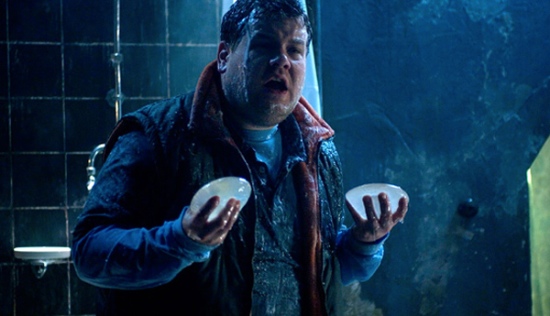
(Thanks to Ogawa for the awesome screencap)


Tuesday, January 5, 2010

The Flim Bolg Top 100 Films of 2000-2009

Sorry for the absence, that is, if anyone is reading this. Took an extended Christmas break, but am hoping to get back in the swing of things.
079. 28 Days Later (Directed by Danny Boyle, 2003): Before I started caring so deeply about movies, cataloguing their faults and flaws, celebrating their acting and cinematography (To be honest, I didn't really know what cinematography meant, really, I still don't. It means if it looks pretty, or not, right?), I saw 28 Days Later with friends and absolutely loved it. A friend of mine proclaimed loudly, upon exiting the theater, that it was the worst film he'd ever seen, sped off in his car, never to be seen again (I'm lying, I saw him a few times after that). I looked at my other friend as the car sped away, "I liked it!" he said, and I did, too. Any film that can elicit that kind of reaction must be worth ranking, right?

28 Days Later is a zombie movie, to be sure. But, whereas the goal of most zombie movies is to make you jump when the zombies spring forth from dark corners and cheer as the heroes lop off zombie heads, 28 Days Later hits you with a much more visceral, deep-in-your guts dread.

When the main character, Jim (Cillian Murphy) awakens in a hospital to find everyone gone, it really gets to you. It makes you imagine the same thing happening to you. As he leaves the hospital and finds the city deserted, and the score swells, and he just looks deflated/defeated, it's absolutely gripping.

Of course Jim finds some fellow survivors, and, of course, they follow a radio signal sent forth by other survivors, and they run from and kill various zombies along the way, it is a zombie movie, after all, even if the zombies are not expressly identified as such. And, here's the kicker, the fellow survivors, are somehow more inhuman than the flesh-eating, staggering zombies.

A thrilling, absolutely terrifying film, that pushes one as close to hopelessness as one can get. Maybe that's why my friend reacted so negatively to it. Maybe he really felt the hopelessness and was frightened at what he felt. His reaction does have as much in common with fear than it does with dislike. That brings me to the ending, I've read people complain about the relatively upbeat ending, but I think it's perfect. After the journey Jim, and the viewer goes through, it would be unfair to give them a downer. At least give them some hope. There's never anything wrong with hope.

078. Children of Men (Directed by Alfonso Cuaron, 2007): I might have monkeyed with my results a little bit to get these two back-to-back, because, in a strange way, their almost companions of one another. Children of Men puts Theo (Clive Owen) in a not-too-distant future, where the human race is completely sterile, no one has kids, no one has hope. As Theo is on his way to work, he finds out that Baby Diego, the youngest man in the world has died, and is almost blown up by a terrorist bomb. He asks for the day off, claiming to be so devastated by Diego's death, to go smoke pot with old hippie Jasper (Michael Caine), who is mourning Diego in his own way, with a special marijuana hybrid that tastes like strawberries. But, Theo isn't really interested in mourning, he didn't even like the man ("He was a wanker," he says), truth be told, Theo isn't really interested in anything.

Eventually, he ends up reconnecting with Julian (Julianne Moore), his old flame from his protestor days. She tries to enlist his help. After much hemming and hawing, he finally agrees to transport a motley assortment of individuals to a destination, provided he gets paid, of course. Their car gets jumped, people get killed, and Theo learns the true value of his human cargo, giving him a reason to fight back, a reason to go on.

The filming of this movie is phenomenal. The bombed-out landscapes, the ongoing battles in the background, the faint promise of hope. While both Children of Men and 28 Days Later deal in similar themes, similar landscapes, similar feelings of hopelessness, and similarly unwillingly heroic heroes, the big difference is in their chief message. In 28 Days Later, it's about keeping yourself alive. In Children of Men, it's about keeping hope alive. It's in the face of the soldiers who stop fighting when they realize just what Theo is escorting. It's in Theo's face, when all is said and done. I wonder if my friend enjoyed Children of Men.

Sunday, December 20, 2009

Film Review: Summer Hours


Summer Hours (Directed by Olivier Assayas, 2009): I wanted to sit on this one for a couple days before writing about it. I have a tendency to overrate/overhype just about anything I have just seen and enjoyed. Then, a few days later after reflecting on it, I realize that my feelings have cooled somewhat (or a lot) and I blush at my earlier rave reviews. And sometimes I walk away from something feeling somewhat let down or bewildered and the film sits in my subconscious and percolates, and I find myself revisiting images over and over like a slideshow in my head and realize that I did, in fact, love the film. And sometimes, it's a film like Summer Hours, where my first instinct is that I loved it, and I wait a few days and realize...that I loved it just the same.

Summer Hours begins at the birthday of Helene (Edith Scob), the family matriarch, attended by her three children and assorted grandchildren. Helene takes Frederic (Charles Berling), the oldest, aside and begins run down an itemized list of her posessions, many of them priceless works of art, and who should get what, and what should be sold, and about selling the house. Frederic is aghast, not only does he not want to discuss his mother’s guest, but he is perplexed at the idea of selling the house. The children will meet there with their families for summer vacations, he reasons. Later, after Helene has indeed died, he repeats this statement as an unanimous fact, despite the fact he’s never talked it over with either of his siblings. The looks on the siblings, Adrienne (Juliette Binoche) and Jeremie (Jeremie Renier), tell it all. Rather than be a silent majority, they both say their piece. Jeremie, the youngest, is set to begin a five-year contract in China. He won’t be able to take advantage of the house for those five years, and likely beyond. Adrienne is getting married for the second time, she says she won’t get back to France more than maybe once a year. They both defer to Frederic, the oldest, but there’s no choice to make here. That’s part of being the oldest: being left to make the decisions, when the decisons have already been made for you, but knowing that if it goes wrong it will always be you who made the final choice. Frederic makes a last pitch to keep some of the artwork, in particular a pair of priceless paintings. But, Jeremie needs money to purchase a home in Peking, and Adrienne rationalizes: “You can’t split two pictures three ways.”

The rest of the story is told in vignettes. Chief amongst those is my favourite scene, a heart-wrenching scenario where assessors pore over every artifact in the house, extolling their values while the the children sit passively by and watch family heirlooms and memories reduced to their finite financial value. Eloise, Helene’s longtime housekeeper stops by, and Frederic, in an act of simultaneous compassion for the woman and defiance against a process he doesn’t believe in, quietly gives her a vase that he knows to have tremendous value, because she, like Frederic, believes the vase has no real value if it’s not full of flowers in a sun-lit room. After exiting the house, she confesses to her relative giving her a ride that she could never take anything of value, that she wouldn’t feel right, not knowing that she has a priceless artifact in her possession.

Berling is stellar, playing a man who believes in nostalgia and sentimentality and wants to keep the house in the family so his children, and their eventual children can meet there and love it the way he did. He is directly at odds with his siblings, who are more materialistic, but also more realistic. Right until the end, Frederic harbours the delusion that he could buy out the other two siblings and keep the house, somehow.

It ends with a joyous house party, okayed by Frederic, seeing as the house will soon be taken over by a new owner, thrown by his teenage daughter. Throughout the film, Helene's children often use the feelings of their own children as reasons for justifying their point of view. Frederic talks about how much his children love the house, while Jeremie admits his children would rather vacation in Bali, then return to a house they have no strong affinity for. And when we first see Frederic's daughter's party: all loud music, booze and guys tooling around on motor-scooters and dirt bikes, we think she has the same inkling as her cousins: that it's just a house she used to visit with no real emotional attachment.

But, then we see her standing in a field of the house's seemingly limitless environs, with her boyfriend, she is brought to tears by the fact that her grandmother is gone, and, soon, the house will be, too. It’s a wonderful moment reinforcing the theme of the film: that people go, that things go, and, once they’re gone you can never get them back, so she goes back to her party. It’s a perfect ending to one of 2009’s best.

Thursday, December 17, 2009

The Flim Bolg Top 100 Films of 2000-2009

081. Slumdog Millionarie (Directed by Danny Boyle, 2008): A hyperkinetic love story. Jamal, a poor orphan from the slums of Mumbai goes on the Indian version of 'Who Wants to Be A Millionaire', not for money or fame, but hoping to reconnect with the love of his life whom he has had to leave behind three times. While on the game show, the questions happen to coincide with major events from his lifetime, and it's through flashbacks that we're told the story of Jamal's life. It's probably the most feel-good film you'll see that includes religious riots, murder, child abuse, prostitution, spousal abuse, and the maddening gap between the haves and the have-nots.

What I love most about Slumdog Millionaire, is how sure-footed and singularly focused it is. It just never really takes a wrong step, and right from the stylish title screen with the kid's t-shirt displaying the title, you know you're in good hands. Terrific soundtrack and some incredibly manic camerawork following Jamal and his brother Salim as they run through the snaking slums of Mumbai.

And, in the end, when Jamal and his lady love Latika lead a joyful Bollywood-style dance number, it feels wrong at first, but you realize that they've earned it, that the movie has earned it. And it's just a wonderful way to end a film.

080. Ghost World (Directed by Terry Zwigoff, 2001): This is a pretty polarizing film. I've read reviews from people who just H A T E D it, and other who think it's just wonderful. I guess you could say I fall into the latter camp, Ghost World is just the wonderfully cynical and witty, yet surprisingly tender-hearted film about growing up.

Thora Birch stars as Enid who is supposed to be graduating, but finds herself stuck in summer-school for art class after flunking out. This puts a crimp in the plans of her best friend and fellow outcast, Rebecca (Scarlet Johanssen), who wants Enid and her to get jobs and get a place together. But, Enid clearly doesn't want to. She drags her heels, she gets a job but gets fired quickly from it, she makes fun of Rebecca's job at a coffee shop. In the midst of making fun of everyone, they pick out a 'Missed Connections' ad from the personals, and set up a phony date for the man who placed the ad.

What they weren't prepared for, however, is just how sad Seymour (Steve Buscemi in one of the best performances of his career) actually is. They feel bad about what they've done, and follow him back to his place, stopping in later in the week to go to his garage sale. Seymour is a vintage Blues record collector, and Enid finds herself interested in him. She ends up liking his old blues records and makes it her quest to find him a date. But, what Seymour really wants is someone like Enid, and what Enid really wants is someone like Seymour, but neither of them is ready to admit it to the other.

As Enid and Rebecca begin to drift apart, the way that high school friends often do, she finds herself spending more and more time with Seymour. At the heart of it all, Enid is actually really unhappy, she wants to be popular with the boys like Rebecca is, but treats any attention paid to Rebeccas as loathesome, eschewing popularity because it's never going to come. She and Seymour are kindred spirits, both slightly out of step with modern life, and both extremely fragile. And the film finds the perfect note to end on, leaving you wondering whether it's meant to be a metaphor for one thing, or the other.

And, to top it all off, it's just genuinely funny. The character of Doug, who is like so many weirdos one finds hanging out at a convenience store, just floors me every time when he begins practicing with his nunchuks in the parking lot.

Tuesday, December 15, 2009

The Flim Bolg Top 100 Films of 2000-2009

082. Grizzly Man (Directed by Werner Herzog, 2005): Grizzly Man is a textbook example of how a viewing experience can taint one's opinion of a film. After months of reading reviews and hearing hype on the film, I found out that Discovery Channel would be airing it in its entirety. I watched it, thought it was all right, and forgot about it. I continued to read hype about it and was baffled about it. Finally, about one month ago, I picked up the DVD to watch it again and was blown away by how terrific it really is. And that reason is: commercials! The Discovery Channel, looking to make back some of the money they'd invested in the film, would run about 3-4 minutes of the film, then put it 3-4 minutes of commercials. The commercials break up the pace, making it a two hour, stilted slog, whereas it's actually a pretty brisk 103 minutes when viewed on its own. But, enough about my complaining about commercials, on to the film, itself.

Grizzly Man is Werner Herzog's documentary about the remarkable life and grisly death of bear-lover Timothy Treadwell. For 12 years, Treadwell would travel north and live amongst the grizzly bears of Alaska for the bulk of the summer and a portion of the fall. He filmed them, named them, and, in his own mind, crusaded against poachers and other hazards the grizzly bears faced. In his thirteenth summer, however, Treadwell and his girlfriend, up much later than usual in the Alaskan wilderness, were both mauled and killed by grizzly bears.

Herzog's documentary is composed of interviews with friends and associates of Treadwell, as well as amazing footage shot by Treadwell, himself, of his interactions with the bears in their natural habitat. Herzog talks to the pilot who flew Treadwell to his campsite and was the man to find Treadwell's remains, to Treadwell's ex-girlfriend who has, in her possession, an audio tape of Treadwell and his girlfriend being killed by the bears, as well as those who were critical of Treadwell's methods. One expert questions whether Treadwell did more harm than good, fighting an enemy (poachers) that weren't really a problem while making the bears used to human interactions, leading them into possibly fatal situations with human beings.

But, Herzog digs even deeper than these conflicts and, in Treadwell, finds a man who is on the outside of society. There are references to Treadwell's difficult relationships with friends and family, and Treadwell's love of the grizzlies borders on mania, such as when he touches bear feces because he's so amazed that they were just inside one of "his" bears, or when he launches into a lengthy, profanity-laced tirade against the Parks Department and other colleagues. Herzog suggests that modern life had passed Treadwell by, and he no longer felt comfortable in the human world.

Watching this with a friend, I came up with the idea that maybe Treadwell's own death was something he cooked up in his own head as a form of noble suicide. There are references made to him fighting with the airline that was intended to take him back down from Alaska and how he and his girlfriend return to the wilderness, much later than usual, with unfamiliar grizzlies. For Treadwell, who, right or wrong, loves the grizzlies so much, I could see this being his idea of a noble death, dying at the hands of a grizzly, his own body acting as nutrients for said grizzlies. It's a fascinating film

Monday, December 14, 2009

Film Review: The Wind Will Carry Us


The Wind Will Carry Us (Directed by Abbas Kiarostami, 1999): There’s not a lot that can be said about a film like The Wind Will Carry Us, really, because there’s not a lot to it, quite frankly. That’s not a criticism, the film has a real beauty and sense of visual poetry, it’s just that the talking points are limited.

There’s an engineer and his team, who drive to a remote rural village in Iran. They don’t say why they’re going, they tell a small child who will act like their guide, that they’re looking for treasure. The engineer inquires about a local woman who is sick, his team sleeps most of the day, then go eat strawberries in the afternoon. Periodically, the engineer gets a call on his cellphone, but the reception in the village is terrible, and he has to get in his car and drive to higher ground, in order to be able to communicate. And this scenario is repeated over and over for the first hour or so. He interacts with the other villagers, talking with the kid, talking to a man digging a ditch, trying to procure milk, these interactions are puncuated by more phone calls where we only hear his end of the conversation, and it becomes eventually apparent that the woman’s health is crucial to their plans, but in what way, we’re not sure until a conversation fairly far into the film reveals that they are, in fact, waiting for the woman to die so they can film the village’s death ceremony.

But, the woman doesn’t die. She starts to get better. The engineer is distraught, the woman’s refusal to die keeps him and his team waiting for weeks. But, you can see a mixed reaction on his face. On one hand, he’s upset that he has nothing to do, on the other, you can’t get angry at someone for living. He asks a villager who has learned of his purpose for visiting if the man thinks that the engineer is a bad man. We can see that it bothers him, which is an answer to his question, itself.

I mentioned the film’s sense of visual poetry. It has that in spades. Whether it’s a long-shot of the engineer driving his truck up to the top of the highest hill, the little boy walking across a fallen tree he uses for a bridge, the engineer hitching a ride on the back of a motorcyle between wind-swept fields, or even something as simple as the engineer shaving with the film’s camera standing in for a mirror, there’s a real beauty in every shot. The Wind Will Carry Us also has the benefits of the village, itself, a dizzying array of alleys and twists and turns. Witness where the scene where the engineer, on a phone call, says he must go to higher ground to able to hear the person on the other end, then proceeds down a set of stairs, because, in order to get to a higher level, he must go down first, then around a corner, then back up a set of stairs to get there.

It’s certainly not a film for everyone. The conversations are rather matter of fact, and there’s not a lot of dialogue to sink your teeth into, and there’s a genuine lack of concern for narrative clarity (I’ll admit, right here, that I actually picked up and read the back of the box, after about forty minutes, to try and figure out what was going on, if I’d missed something in the dialogue to explain what exactly they were supposed to be doing). It’s slow, which will throw some people off immediately. It’s the kind of film that I enjoyed, but if someone said to me “I hated it”, I couldn’t really blame them, because, like I said, it’s definitely not something that’s going to have a universal appeal. But, it’s so beautiful to look at, that I think everyone should at least see it before forming an opinion.

***

Sunday, December 13, 2009

Film Reviews: A History of Violence & Dead Ringers


A History of Violence (Directed by David Cronenberg, 2005): I was rather non-plussed when I saw this for the first time, four years ago. Of course, it was an awkward visit to the theater, considering I saw it with my mother and father (Boy, those sex scenes made the trip extra-awkward), and some employee was vacuuming the back hallway behind the theater for the last half-hour, or so. But, upon rewatch, I’m still not a big fan. My biggest problem with it - and you can blame me for committing the unpardonable sin of the movie reviewer - is that it didn’t really go where I wanted it to go. I loved the story of the two hoods coming to this small town and a mild-mannered diner owner, Tom Stall (Viggo Mortensen) who leaps into action when needed and kills the two hoods. I loved the idea of said diner owner getting hounded by a mysterious mobster (Ed Harris) who thinks Tom is someone else, a hood named Joey from Philadlephia. But, I am not really onboard with the whole


>>[SPOILER]Tom IS actually a who the mobster says he is, a hood from Philadelphia who buried his past and assumed a new identity[/END SPOILER].<<


Something about the last third just doesn’t strike me as believable. I’ve read reviews which detail how it plays around with the idea of self-identification and what makes us who we are, but I don’t think the film does a really good job of explaining or exploring this territory. If the film is about this idea of the self and what makes it, then it should get to this point much earlier in the story. By the time we get the big reveal about Tom, it’s two-thirds into the film and we’ve become invested, as an audience, in the story of Tom, that the second part of the plot never really takes hold.


Further,


>>SPOILER]Since all we really ever learn/know about Joey is that he was a nasty person and super-hood from Philadelphia, we never really feel any apprehension when he confronts his brother. I mean, if Tom Stall can battle mobsters with few problems, it stands to reason that Joey, who is Tom minus all sense of good and responsibility, would have even less problems with said mobsters. It removes all the tension from what should be a very tense situation.[/END SPOILER]<<


I also think a lot of the dialogue is really overwritten, particularly Tom’s son who never sounds like a high-school kid, rather a theater student in his mid-twenties. So, while I can admire the movie’s strongpoints: great performances by Mortensen, Harris, and Maria Bello; intense action sequences that show real results of violence without glorifying them (Though they are still kind of cool); and a weirdo, spirited casting choice of William Hurt as a mobster, that almost works, I can’t quite recommend it.

**1/2


Dead Ringers (Directed by David Cronenberg, 1988): Dead Ringers, on the other hand, does a much better job of exploring the realm of identity and the self. Jeremy Irons plays the role(s) of twin gynecologists, Beverly and Elliot Mantle. And what a performance it is! You actually find yourself watching it, and being able to tell who Beverly and Elliot are separately, because Irons does such an incredible job of playing each twin as a completely separate person: Bev, the introverted super-doctor who has a wonderful compassionate bedside manner but has difficulty communicating outside of his clinic, and Elliot, the smooth-talking brother with a knack for wooing the ladies, but can’t really communicate on any deeper level than seduction. After Elliot seduces an actress, Claire (Genevieve Bujold), he gets Beverly to take her out the second time, because he recognizes that Elliot will never meet women without his help. But, where Elliot finds Claire to be an interesting diversion, like all women he meets, Beverly makes a much deeper connection with her. He begins to have difficulty operating without her, and when she finds out the twins’ scheme, cuts off all contact with them. Beverly is devastated, and begins to take drugs to cope with her absence, and beings to spiral out of control. Her return doesn’t help, as she indulges his drug habit with her own, but the two manage to peacefully co-exist, though Elliot feels shunted aside. When she goes away on a shoot, and Bev suspects her fidelity, it’s more than he can take, and he begins to have difficulty operating not just in the outside world, but even in his sanctuary, the clinic. Elliot recognizes his brother’s suffering, and decides he must suffer with him, that it’s the only way he can pull him out of the nosedive.


It’s a fascinating film, contrasting the grotesque (Beverly’s nightmare, surgical scenes, and Beverly’s growing infatuation with “mutated women”, as well as a gory finale), with scenes of surprising beauty, like Elliot looking after his brother, or the opening sequence that’s a flashback to their childhood attempts at “seduction”.


But, this is Irons' picture as much as anyone. And Irons is phenomenal, playing both characters as completely different people, at times you forget it’s the same actor in both roles. As a Canadian, it’s quite refreshing to see that we got it right for a change, when Irons was chosen as Best Actor at the Genie Awards (Canada’s Oscars) while the Academy Awards failed to even nominate him.

****

Saturday, December 12, 2009

Film Review: The Savages


The Savages (Directed by Tamara Jenkins, 2007): I did not expect to like The Savages because I had it pegged as something it’s not. A few years back, I was a finalist in a short fiction contest and was flabbergasted at the results. Not because I didn’t win, but because of what did win. It was a short story about a girl who worked in a retirement home, and used the elderly there as comic relief, an idea even more in bad taste than it sounds. And that is what I expected out of The Savages, the story of two middle-aged people (Philip Seymour Hoffman and Laura Linney) having to take care of their elderly father as he begins to suffer from dementia. The opening credits did nothing to dispel this fear either, with shots of old people dancing, tooling around in golf carts, arguing with the care-givers. But, the film’s not about that. The film is very direct and, even downright brutal, at times, about what happens in the last days of a person’s life.

Lenny (Philip Bosco) was not a good father, running out on his family, with some suggestions that before he left, he was abusive, as well. When Lenny’s girlfriend passes away, her children kick him out of the home they’d been paying for, leaving Jon (Hoffman) and Wendy (Linney) to have to fly out to Arizona, and figure out what to do with their father. The children’s lives are messes: Jon is struggling to complete a book on Bertolt Brecht while refusing to commit to his soon-to-have-her-visa-expire girlfriend, while Wendy is a wannabe playwright forced to work temp jobs to make ends meet while having an affair with a married man. They bring him back to Buffalo and put him in an assisted living facility, and Wendy moves in with Jon so that she can visit her father more regularly. The performance by Bosco is incredible, as a man trying to hold onto whatever scraps of dignity he has left by flying into fits of rage, while having to be subjected to humiliations like adult diapers, discussions of his post-mortem procedures, and his kids fighting about him, in front of him, without even asking his opinion.

But, I’m making this seem like an unnecessarily dire experience. It isn’t. There’s actually a lot of humor to be mined in the situation. The relationship between Jon and Wendy is spot-on, as they both compete to prove they’re not as maladjusted as the other sibling, while struggling with the feelings of being there for someone who was not there for them. There’s a movie night where Jon’s choice of an old film to boost his father’s spirits is not met with enthusiasm by the caregivers. And there’s a feisty cat who creates one of the most humanly enjoyable scenes in the film, where Wendy befriends one of the caregivers.

The Savages is really a wonderful film. It does not sugar-coat the facts about what happens as somebody’s life approaches its end, but it finds humor and humanity in the situation, without stripping the dignity away from the people who have lost so much of it already. I wish I could go back and show that woman who wrote the short story this film and say “There, that is how you do it.”

****

Friday, December 11, 2009

The Flim Bolg Top 100 Films of 2000-2009


083. City of God (Directed by Fernando Meirelles & Katia Lund, 2003): The title is evocative, because if there is a place that represents absolute godlessness, it’s the City of God, the title given to a section of slums in Rio de Janeiro. The film is told through the eyes of Rocket, a young man trying to make it in the slums, but it’s unfair to say he’s the main character in the film. In fact, he might not even be the main character in his own life. Lil’ Ze looms large over this film. Younger associate of a gang of smalltime hoods, Ze’s thirst for murder and mayhem makes him a bigger figure than they could ever be, eventually he becomes the kingpin of the entire City of God when, on a whim, he decides to murder the slum’s various leaders of the drug trade because that’s where the money lies. Benny, his longtime associate, is the brains of the outfit, the only one who can possibly quell Ze’s rage and direct it in the appropriate manner. When Ze becomes jealous of Benny’s ways with the ladies, he directs his fury towards a random guy walking home with his girlfriend and creates the legend of Knockout Ned, the only guy willing to stand up to Ze. Rocket, working for a newspaper, now, takes photos of the goings-on and soon becomes a photographer for the paper, as Ned and Ze head toward a climactic showdown.

City of God is a film of unbridled fury and kinetic energy. It’s the kind of film where the history of an apartment is detailed, spanning many years, yet is covered in just over two minutes of screentime. Or witness the opening scene where a scene where hoodlums chase down a runaway chicken, only to find themselves face-to-face with the police, and Rocket is in the middle as the camera rotates around him, showing that he’s trapped on all sides, with no visible way out.

The violence in City of God is often an issue that comes up as a talking point about the film, especially in light of the scene where one child is told to shoot another, but it’s never excessive. One never gets the sense that any of the violence in City of God is justifiable, or cool. And violence always comes with a price. Witness the ending where a new generation of gangster seems poised to take control. A new breed with no qualms about killing, and no qualms about killing for no real reason, rather than a rather abstract goal that they have no means to accomplish or knowledge of how to make happen. In City of God, violence begets violence, with no seeming end. It’s a wake-up call, and a fascinating film.

Thursday, December 10, 2009

The Flim Bolg Top 100 Films of 2000-2009

Apparently I lied, I thought there was a comedy in this pack. Soon, honest...

085. Brokeback Mountain (Directed by Ang Lee, 2005): A heartbreaking film. Everyone lost their minds last summer about Heath Ledger's amazing Oscar-winning performance in The Dark Knight, overlooking the fact that he'd topped that performance four years earlier in Brokeback Mountain as Ennis Del Mar, a man so quiet and closed off, he'd seemingly just as soon bite his own tongue off as talk too much. He ends up camping on the titular mountain with fun-loving rodeo-rider Jack Twist (Jake Gyllenhaal). By day, Twist is called upon to look after the sheep, riding back to camp in the evening where Ennis cooks dinner, before riding back out to camp out with the sheep. Considering they're basically hired to play house on the mountainside, is it any surprise when they develop affection for each other? Neither of them will own up to their feelings ("You know I ain't queer," Ennis tells Twist), and once their seasonal work is over, they part ways, ostensibly forever. Ennis marries his longtime sweetheart (Michelle Williams), while Twist falls for female rodeo rider Anne Hathaway. But, neither can forget the other, Twist even tries to get rehired the following year to work on Brokeback, but is turned away by the boss, who has stumbled upon their secret. Eventually they begin to meet for fishing trips, rendez vous, what have you. Because of their time and place, they can't reveal their love, their feelings for each other. In that sense, there love is more of a curse than a blessing. Their moments together are too short, the moments in between too long. Ennis' wife stumbles upon his forbidden love and leaves him, and he stumbles about day to day, with nothing really to do. One of the saddest films I've ever seen, with beautiful cinematography, superb acting, and a great score.
\

084. Happy Times (Directed by Zhang Yimou, 2000): Fascinating human comedy that could only come from outside of the Western world, because, well, it's too darn weird. Zhao is a big dreamer, trying to woo a woman despite his lack of funds. He and a friend decide to rent out an abandoned schoolbus to young couples in need of privacy, and use the money to fund a a wedding well out of his price-range. His fiancee pawns off her step-daughter on him, thinking that since Zhao is presenting himself as a hotel owner, he can surely find a job for Wu as a masseuse. Wu is blind, so Zhao concocts a scheme where he places Wu in an abandoned building and sends his friends in as her clients. The massages are brusque and mechanical, never looking at all beneficial, sometimes even looking painful. They loop a cassette recording of downtown ambiance in the building so that she doesn't suspect the deception. Even though their relationship is based entirely around deception and trickery, Zhao begins to care for the poor unwanted girl, and she appreciates everything Zhao is doing for her, even as she begins to suspect it's not on the up and up. Roger Ebert expressed some grave misgivings about the plot, and the idea of a comedy based off of tricking a blind girl, but I think he's placing values on it that the film isn't interested in. There's nothing vaguely sexual or mean-spirited about what he's doing with Wu, it's just a guy without any means, trying to get along the best way he knows how. In the last stretch, the movie takes a shockingly serious turn, and it's really moving and sad.

Tuesday, December 8, 2009

The Flim Bolg Top 100 Films of 2000-2009

I didn't plan for this day to be so full of sad, sad films, it just turned out that way. I promise, there's still some levity coming up, hopefully tomorrow.


088. In America (Directed by Jim Sheridan, 2002): "Don't "little girl" me," the young girl says, staring into her father's eyes, "I've been carrying this family on my back for over a year." The father (the wonderful Paddy Considine) is shocked. He seems to think he and his wife have been coping well since the death of their son, never realizing the daughter has been taking the brunt of it, trying to maintain a happy face and take care of her younger sister while her parents trudge along, grief-stricken. "He was my brother too," she says. It's that kind of scene that separates In America from the rest of the pack, and elevates it above what could have simply been a tear-jerking nostalgia flick. That kind of emotional honesty is rare, and the performance by Sarah Bolger is sublime.

It's the story of an Irish family moving to New York City. They move into what is, ostensibly, a slum. But, they're happy, because it's New York City and it's so alive. The father struggles along, trying to make a go as an actor while taking odd jobs in the interim, the mother gets pregnant, the girls befriend an ailing artist who lives in the building, but the deceased brother is the elephant in the room. A game of hide-and-seek becomes a miserable experience when the father finds himself looking for his son. It's not an easy watch, it's extremely emotionally draining. But, ultimately, it's a rewarding one.

087. The Proposition (Directed by John Hillcoat, 2005): The idea of an Australian Western conjures the images of Crocodile Dundee riding on the back of a kangaroo, throwing boomerangs. In actuality, this is one of the bleakest, harshest films I've ever seen. Guy Pearce is Charlie Burns, middle brother of the notorious Burns Gang. He is caught at the hands of Captain Stanley (The remarkably under-appreciated Ray Winstone), who offers him the titular proposition. Either Charlie can rot in his prison, and watch his youngest brother Mikey be executed by the state, or he can be freed on the condition that he bring his older brother Arthur to justice. Justice, in the Australian outback, being a synonym for death. Ultimately, he goes for the second option, and proceeds, alone, to track down Arthur, memorably brought to life by Danny Huston. Mikey, simple by nature, is seen as the most innocent brother, Arthur, by contrast, is evil and unhinged. When he finally finds Arthur, at first we're charmed by him, his rag-tag family he's created for himself, his propensity for poetry, but, eventually, we're let in on the secret: Arthur is vicious, brutal, and completely without remorse. Meanwhile, Stanley is pressure from the locals to punish Mikey, and has to stand firm in the face of criticism, unable to let the townfolk, including his wife, in on his deal. If they'd known he'd let Charlie out, no matter the circumstances, they'd be calling for his own head.

As memorable as all the performances are, the real star of The Proposition is the locale. The Australian Outback, often celebrated and shown as a sort-of last bastion of unspoiled beauty, has never looked more unforgiving as it does here. Hot, desolate, weather-beaten, as vicious as the men who trample upon it.

I have yet to see Hillcoat's The Road, but I can't help he adapted the wrong Cormac McCarthy novel. If there's anyone who is born to adapt Blood Meridian, it's Hillcoat, as The Proposition evokes McCarthy's tale of murderous horsemen along the Mexican border, more than any cinematic Western before or since.


086. Million Dollar Baby (Directed by Clint Eastwood, 2004): In what was thought to be Clint Eastwood's swan song on a great acting career, Eastwood played the role of cranky boxing trainer Frankie Dunn who trains Maggie Fitzgerald (Hilary Swank). At first, he's reluctant to take her on: "I don't train girls", he snarls at her. But, after being abandoned by his protege, he finally begins to admire Maggie's courage and takes her on. Their relationship: two shattered souls leaning on each other for courage, hits all the right notes and never missteps. There's no awkward moments, or hints of romance, just a genuine kinship memorably evoked by two terrific performances.

What I find most fascinating in Million Dollar Baby, is what goes on in the background of the boxing gym. If you've ever watched Rocky and found yourself wondering what's the story of the individuals in the background, then this is the film for you. There's Danger Barch (Jay Baruchel), a scrawny talentless boxer who comes to the gym every day to train, never once setting foot in the ring, and threatening to challenge a long-since retired pro fighter. There's Shawrelle Berry, who never seems to much except taunt the various boxers around the gym, trying to coax Danger into a bout, and his friend who plays a low-rent Don King to Shawrelle's Mike Tyson. And, there's Eddie Dupris (Morgan Freeman), a former boxer who now cleans up after Frankie's various trainees and misfits, sleeping in the back room, never once lamenting his lot in life. They all have a role in the film, and at the climax, you can't help but stand up and cheer.

But, the film belongs to Eastwood and Swank. As Maggie becomes more and more dear to
Frank, a funny thing happened to me. For the last thirty, to forty minutes of the film, I developed an awful knot in my stomach, knowing something bad was going to happen, and something bad most certainly does, but I couldn't turn away. I'd never experienced that before, becoming so emotionally invested in a character, that it actually brought me physical pain. It's a testament to how fully-realized these characters are. Ultimately, in the end, as Eastwood's character is asked to do the impossible by Maggie, a decision that, no matter what he chooses, we, as the audience know it will emotionally destroy him, you can't turn away, because that's what life is: a few people we meet, know and love, and ultimately, in one way or another, have to say goodbye to

Monday, December 7, 2009

The Flim Bolg Top 100 Films of 2000-2009


090. Babel (Directed by Alejandro Gonzalez Inarritu, 2006): Babel is a film about communication. Now, that may seem rather obvious considering the title is a reference to the biblical Tower of Babel, where God punished the builders of the tower by confusing their languages, so no one could communicate with anyone, but I've seen many references to this being a lesser Crash which, to me, completely misses the mark. There are four spoken languages, sign language, but, in the end none of it is sufficient. Only the viewer, with the aid of subtitles, has the opportunity to understand everyone. Most stunning, to me is the Japanese segment with Rinko Kikuchi delivering a splendid performance as the deaf-mute Chieko. It's the least obvious and explained segment, but takes on the most issues with Chieko's coming of age in a society that tends over-sexualize young women getting equal time with her suspicions of her father. The closing shot with Ryuichi Sakamoto's 'Bibo no aozora' playing with the shot of Chieko and her father on the balcony is too stunning for words.


089. Encounters at the End of the World (Directed by Werner Herzog, 2008): What separates Werner Herzog's stunning documentary from your standard nature doc, is Herzog's complete refusal to romanticize the images he shoots. He gives equal screen-time to the people who populate and work in the Antarctic, as the animals who dwell there. The beauty is in the psyches of these individuals: the immigrant from behind the Iron Curtain who keeps a bag packed so he's ready to escape at any instant and tears up at the thought of what he's witnessed; the woman who has travelled all over the world in various forms like a pipe in the back of a truck who can turn herself into her very own carry-on luggage; or the two scientists who celebrate their successes with a late-night jam session atop the roof of their headquarters. That's not to say he doesn't show poignant images of the animals. The undersea cinematography of the various beautiful and grotesque creatures beneath the sea is sensational, and there might not be a more haunting shot of any film from 2008 as when Herzog films a penguin getting disoriented and running away from its colony, likely on the path to certain death. A great film.

Sunday, December 6, 2009

Film Review: Five Easy Pieces


Five Easy Pieces (Bob Rafelson, 1970): I can't quite put my finger on exactly why, but, after seeing this for the first time, I absolutely adored it. Jack Nicholson plays Robert Dupea, a piano-playing prodigy who left it all behind to toil away at random odd jobs. Currently, he lives with a woman he treats badly, works in the oil fields, pals around with his simple friend, and picks up easy women in bowling alleys. Gradually, he grows tired of the day-to-day grind, culminating in a wonderful scene where, idled in seemingly endless traffic, he exits his vehicle, argues with a barking dog, then climbs onto the back of a moving truck and plays a piano as the traffic finally abates, taking him away from his initial destination. He finds out his father is ailing, picks up and travels north to Washington. The road trip is fascinating, when he picks up a lunatic obsessed with cleanliness and her friend (And it's Toni Basil! Who sang "Hey Mickey, you're so fine!"!!!) who rail about cleanliness and man's destructive tendencies and fight with Robert's girlfriend, until Robert finally tells them all to shut up. It is with this unique company that we get the iconic diner scene, where Robert famously tells a waitress to hold the chicken between her knees. Finally arriving at his father's, he is dismayed to find him unresponsive, felled by a stroke, unable to communicate except the occasional narrowing of the eyes. Along with his father, is Robert's sister, his injured brother, and his brother's student (or is it more?). He immediately falls for the student, who is keenly interested in him, but is it love, or artistic curiosity? She asks to hear him play and he plays a piece and she is deeply moved, until he reveals that he simply picked the easiest one he knew, and that he played it better when he was eight and felt absolutely nothing when he played it, annoying her. I won't spoil the rest, but it's really wonderful. I sometimes feel like Jack Nicholson coasts on his reputation, that he is praised for rather middling work, simply Jack playing Jack, really. But, this is a terrific performance. It's got all the trademark Nicholson moments: smart-alecky comments, that sneering voice, but it also has some rare displays of genuine acting chops: like Robert's teary conversation with his father, where he gets to the very being of his soul, and a tremendous ending where he tells everything in few words. I was really blown away by this. Tremendous.
****

Thursday, December 3, 2009

The Flim Bolg Top 100 Films of 2000-2009

093. Gozu (Directed by Takashi Miike, 2003): You might be shocked when I tell you right now that for those of you curious as to when and how high Mulholland Drive will be, you can stop waiting; it's not on my list. It's just one of those movies I didn't get. Yeah, yeah, I've read all the reviews, all the championing, the it's a dream but it's not arguments. I was into it, I was all for it, then it lost me sometime around the part where the tiny people run under the door. So, it's going to seem even more hypocritical when I praise Gozu for many of the flaws I fault Mulholland Drive for. Because, as near as I can tell, Gozu makes no sense. There's a lead character who senselessly, violently (and nice and phonily, for all you animal wussies out there, like myself who can't stand to see animals hurt onscreen) kills a poodle to open the film, because it's a Yakuza attack dog that is trained to kill Japanese gangsters. There's a guy who just kind of disappears, only to reappear in the last, and let me stress it again, the last you'd expect him to turn up. There's the guy above, with the facepaint, that I don't believe is ever explained. And there's my favourite scene, where a character who was just interacting with another character is informed that the person he was talking to has been dead for years. He registers shock on his face, the musical cues tell you that something is about to happen, the characters look offscreen, and...a door opens, to reveal a guy taking a shit. He looks at the characters. He screams. They scream. And I'm pretty sure he never turns up in the film again. As a devoted plot guy, this is something I should detest. I get annoyed by Mulholland Drive for not being easily explainable. I don't know why. I don't need my films wrapped up tight with a neat little bow, but, for some reason, that's what I want out of Mulholland Drive. Why don't I want that out of Gozu? I couldn't honestly tell you. Maybe it's the ABSOLUTELY INSANE ending. *[SPOILER ALERT] Where the missing character from earlier, finally turns up, inside the womb of a woman, who she then gives birth to, sending him sliding across the floor with a Looney Tunes-worthy "POP!"*[/SPOILER ALERT] There's something so raucous and rigidly defiant about Gozu. It's the kind of film that you can't explain why you love it, only know that you do.

092. Shaun of the Dead (Directed by Edgar Wright, 2004): It was a toss-up between this and Hot Fuzz. Maybe I should've included them both. I went with this one, because I feel it has a bit more going for it in the rewatch category. I mean Hot Fuzz is maybe the most I ever laughed in the theater, but upon the second and third times, it's still funny, but it's diminishing returns in the laugh department. But, something about Shaun of the Dead makes it funnier each and every time. There's something so genuinely enjoyable about watching two buddies take on zombies: picking through the record collection and assaulting the zombies with only "bad" records, or bashing their heads in in perfect time to Queen's 'Don't Stop Me Now'. The Zombie genre is a subcategory of horror films that I never really got into, but the more stuff I see, the I realize just how faithful Shaun of the Dead truly is. Whereas Hot Fuzz plays like a send-up of the action movies Nick Frost's character claims to love, Shaun of the Dead plays like a love letter to the Zombie flick genre. Maybe that's why there's more to enjoy each and every time it's on.


091. Elf (Directed by Jon Favreau, 2003): Elf? Really? Yes, Elf! Why? Because it did something I thought was completely impossible: make a genuinely enjoyable, funny and moving Christmas movie without making it too "mature" (By, "mature", I basically mean scatological or sexual humor. I don't know why that's called "Mature". It's like when 'Family Guy' plays on TV and it says "The following program contains mature humor." That sounds to me like 'Frasier'. In my head, right now, I'm picturing Peter Griffin making jokes about politics and art and wine. It's...kind of funny.), too tear-jerking, too condescending. Instead, you get this Will Ferrell performance that, while it could never be considered a tour-de-force acting performance, could not have been pulled off by anyone else. There's simply no other living actor who could have pulled off the performance that Ferrell did. It's this astonishing exhibition of honesty, and sincerity, and goodness, with just enough weirdness to make it entertaining. Think about it. Ben Stiller? Probably not innocent enough. Steve Carrell? Not goofy enough. Vince Vaughn? Too knowing. Daniel Day-Lewis? Too intense. Javier Bardem? Too ethnic. Seriously, though, it's the kind of performance that gets overlooked, but there really is no other actor that could pull this off. But, it took a semi-serious film like Stranger Than Fiction before people said: "Hey, Ferrell's not bad." But, he's been more than not bad for years. I realistically think that one day he'll get an Academy Award nomination, probably sometime in the future when somebody stuntcasts him, after his box office power has faded, like Will Smith's recent run of becoming a semi-serious actor. And when that day comes, people will mistakenly point to Stranger Than Fiction as an atypical role where Ferrell was allowed to play against type and show off. But, that's wrong. THIS is the film. It's just this wonderfully balanced role. Watch his face as he sets off on his trek to find his father. Or the look of genuine joy when he discovers NYC. Or the look when he falls for Zooey Deschanel? (And, frankly, who wouldn't!). Also, the angry little person!